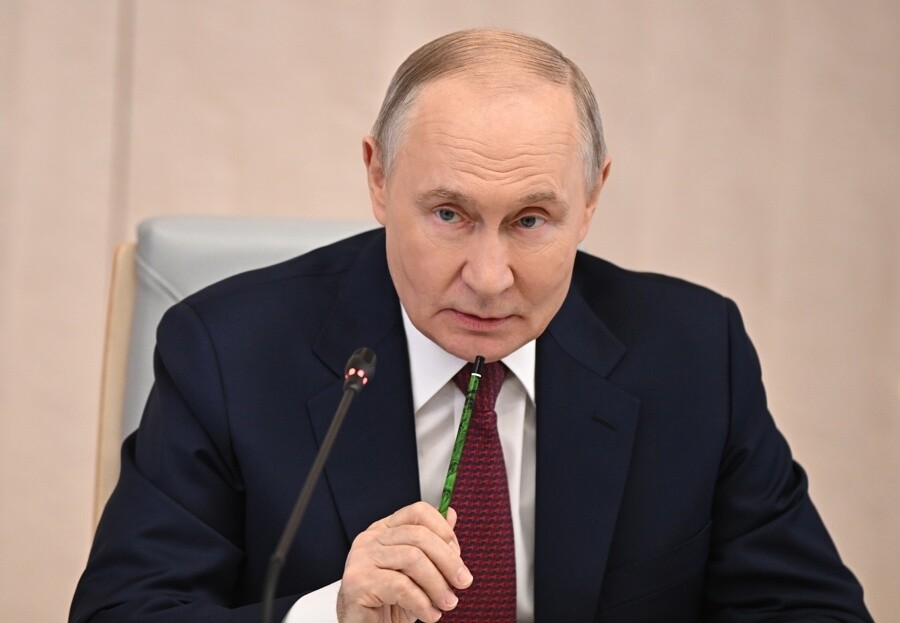
The perfect storm —weariness with the war, internet blockages, and economic contraction— has hit the popularity of Russian President Vladimir Putin and his party, United Russia, ahead of the parliamentary elections. To this must be added the culling of thousands of heads of livestock on private farms in Siberia, which has sparked public outrage, as veterinary authorities did not do the same with large agricultural cooperatives. Lowest levels of support since the war According to the poll conducted by the state-run company VTSIOM, only 32.1% of Russians mentioned Putin among their favorite politicians, when two years ago that indicator reached 48.8%. Furthermore, approval of Putin's management fell to 70.1% and confidence in his figure to 75% (71% and 74%, according to FOM), the lowest levels since the war began in February 2022. Those indicators did not fall that low even when Ukrainian troops partially occupied the Russian region of Kursk or when the head of the Wagner group, Yevgeny Prigozhin, led an armed uprising. The Kremlin's party has also paid a high price, which hopes to renew its constitutional majority in the September parliamentary elections. If the vote were held this Sunday, only 29.3% of Russians, less than a third of those surveyed, would vote for the official party, compared to 33.8% in January. One of the reasons is the fact that the military campaign in Ukraine reached its 1,500th day on Friday with no signs of victory on the horizon. The spring offensive has just begun and Russian troops are far from taking all of Donbas. According to the Levada Center, two-thirds of Russians, 67%, demand the holding of peace negotiations with Ukraine, a demonstration that Russians do not believe that Putin has taken the negotiations held so far seriously. As for support for the war, polls also indicate the lowest level since the start of the conflict with 24% backing. Other reasons are the greater economic contraction of the war -2.1% in January- and the cover-up of the causes of the livestock culling in Siberia. Social media is ablaze with comments that the authorities do not want to admit that it may not be an epidemic of pasteurellosis, but something much more serious, such as foot-and-mouth disease. The internet is untouchable Although the reason that has most damaged the Kremlin has been the internet blockade, which has placed Putin's supporters and the opposition, pacifists and war hawks, in the same camp. A majority of Russians oppose the slowdown in mobile internet, which hit Moscow and St. Petersburg for three weeks, but has become the norm in the rest of the country. Among young people, surveys show that over 80% oppose restrictions on access to the network, which they consider a basic human right. As for the blocking of social networks, especially the messaging networks Telegram and WhatsApp, 55% are against, a figure that was just over a third in the middle of last year. On the side of the bans are Putin and the Federal Security Service (FSB), on the opposite side are students, liberal professionals, businessmen, the banking sector, part of the Government, governors, officialist bloggers and many military units. The press assures that the internet blockade and the persecution of VPNs have divided the elites. The best example is that the son of the number two of the Presidential Administration, Sergei Kiriyenko, runs VK, the Russian Facebook. Meanwhile, people and family members linked to high-ranking FSB officials, according to the press, work for companies that supply equipment for blocking and controlling the internet. Faced with growing popular discontent and to stop the collapse in the polls, the authorities did not carry out their threat and did not completely block Telegram on April 1. The publication «The perfect storm hits Putin's popularity» was first published in La Verdad Panamá.