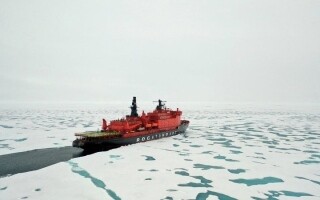
Russia seeks to shape decision-making within NATO by creating uncertainty. The Arctic is an area where Russia can demonstrate its resolve, test the limits of the alliance's response, and maintain its influence in an escalation without entering into open military conflict. Strengthening PositionsOperational control and maritime awareness in the Greenland-Iceland-United Kingdom (GIUK) Gap, which separates these nations, remains critically important for NATO's ability to maintain freedom of movement in the Atlantic amidst resurgent Russian efforts. European allies with national security interests in the region must make targeted investments to strengthen their positions and ensure NATO's combat capability in this strategic maritime chokepoint. Russia, like China, has already declared its ambitions in the Arctic and is well aware of the region's strategic importance. The Russian Northern Fleet has year-round ice-free access to the Atlantic via the GIUK Gap from Murmansk on the Kola Peninsula. Moscow is building and developing bases in remote Arctic territories, including Franz Josef Land and Novaya Zemlya, deploying air defenses, and conducting regular naval exercises to normalize operations in the High North and the Arctic. Russia backs this stance with a large fleet of Arctic-capable icebreakers. Over half of the Arctic Ocean's coastline lies in Russian territory, and Moscow has rebuilt dozens of sites and facilities from the Soviet era to assert its dominance. Multilateral blocs must adapt to this situation, or else bilateral maneuvers between powers could dominate the High North's future. Russia's military buildup in the Arctic is driven by Moscow's fear of limited space for its maneuvers elsewhere, which it traditionally uses as tools for deterrence and pressure against Europe and NATO. Despite numerous hot spots capturing global attention, policymakers in Washington, along with the President, must focus more on the Arctic—not only on how it is changing and the opportunities it presents, but also on how Moscow and Beijing are acting in the region. The Arctic contains vast untapped hydrocarbon reserves, estimated at 90 billion barrels of oil (16% of the world's undiscovered reserves), natural gas reserves, and significant deposits of precious metals essential for advanced technology and the clean energy transition. Asserting DominanceRussia has long viewed the Arctic as the core of its security and economy. Meanwhile, the Netherlands is purchasing an Arctic-capable surface vessel but lacks effective maritime patrol aircraft, which is crucial for any major future conflict in the region. Germany has become critical to efforts for North Atlantic security, aiming to become a regular participant in patrols through the GIUK Gap. Recent controversy over Greenland's future, ignited by U.S. President Donald Trump, has drawn American public attention to Arctic security, but there is a broader story to tell about the region's importance as well. Increasing CompetitionThe Arctic is an area of growing importance for energy, security, and geopolitics. Consequently, Russia has sought to modernize its military bases, air defenses, and nuclear capabilities in the region, conducting operations to deter NATO. Continued sea ice melt is opening access to the region, yet the intensifying competition among major powers has turned the High North into a frontline of strategic rivalry. Russia's dominance over half the Arctic coastline and deepening the 'borderless' partnership between Beijing and Moscow are reshaping access to resources, routes, and influence, increasing escalation risks. Protecting routes, resources, and stability requires strong diplomacy, but the dynamic between Russia and China introduces new risks, including below-the-threshold competition and hybrid threats. From the Atlantic CouncilA Challenge ArenaThe Arctic is no longer just a climate or resource issue; it has become a geopolitical arena where deepening Russia-China cooperation challenges Western dominance, reshaping the energy, security, and trade sectors. At the same time, NATO possesses only a handful of icebreakers, giving the alliance extremely limited capability in ice-covered waters, even as the U.S. turns to the 'Cooperation on Icebreakers' initiative with Canada and Finland to begin renewing its icebreaker fleet. Deterrent CommitmentsFurthermore, Russian Yasen and Borei-class submarines are designed to penetrate traditional detection systems, equipped with cruise missiles and advanced hypersonic missiles, posing a threat to NATO assets. All these nations are investing in new ships and aircraft suitable for operations in the North Atlantic, but they need to calibrate and accelerate the pace. The UK has begun strengthening the 'Atlantic Wall' with new contracts for acoustic sensors and uncrewed vehicles, while Royal Air Force P-8 Poseidon aircraft regularly patrol the Hebrides and the Norwegian Sea. Denmark and Norway are updating their surface fleets, purchasing ships equipped for Arctic operations, and dedicating resources to participate in multi-national force patrols. The NATO Parliamentary Assembly has publicly stated that the increasing 'competition' from Russia in the Arctic and the region's strategic importance make it essential to bolster deterrence and the defensive posture of allies in the High North. There is a growing consensus within NATO that developments in the Arctic should be considered an integral part of the allies' efforts to adapt to changes on the Northern Flank. Since the start of Russia's war against Ukraine in 2022, Moscow has increased its involvement in the Arctic, where the region has gained central importance for Russian deterrence credibility, reinforcement routes, and escalation management amidst growing pressure from Western allies, including sanctions, diplomatic pressure, and NATO expansion after 2022. Russia's military buildup in the Arctic is not aimed at responding to NATO's 'hostile actions' but is driven by Moscow's fear of limited space for its maneuvers in other parts of the world, which it traditionally uses as tools for deterrence and pressure against Europe and NATO. The shortest route for ballistic and cruise missiles to strike North America lies over the Arctic. The Arctic, home to Indigenous peoples and unique ecosystems, remains threatened by various actors and sea ice melt, yet strategic priorities now dominate the discourse. NATO's Standing Maritime Group One conducts regular patrols in the GIUK Gap and the High North, with Denmark leading the latest patrol, followed by the Netherlands. Exercises such as 'Active Endeavour' and 'Northern Viking' test anti-submarine warfare capabilities between surface ships, submarines, maritime patrol aircraft, and helicopters. The recent deployment of UK Royal Air Force P-8 Poseidon aircraft to Iceland has enhanced the strategic value of forward operating positions for anti-submarine operations. However, these measures do not amount to a coherent, theater-wide plan to strengthen the barrier against Russia's growing and capable fleet. Regular PatrolsThe future of deterrence depends on a group of frontline allies: the UK, the Netherlands, Denmark, and Norway, and the German presence will be crucial. As Europe gradually adapts to deterrent commitments, Russia is already deploying the necessary tools and platforms to counter the alliance. While NATO has not been oblivious to this threat, its efforts are fragmented and weak.