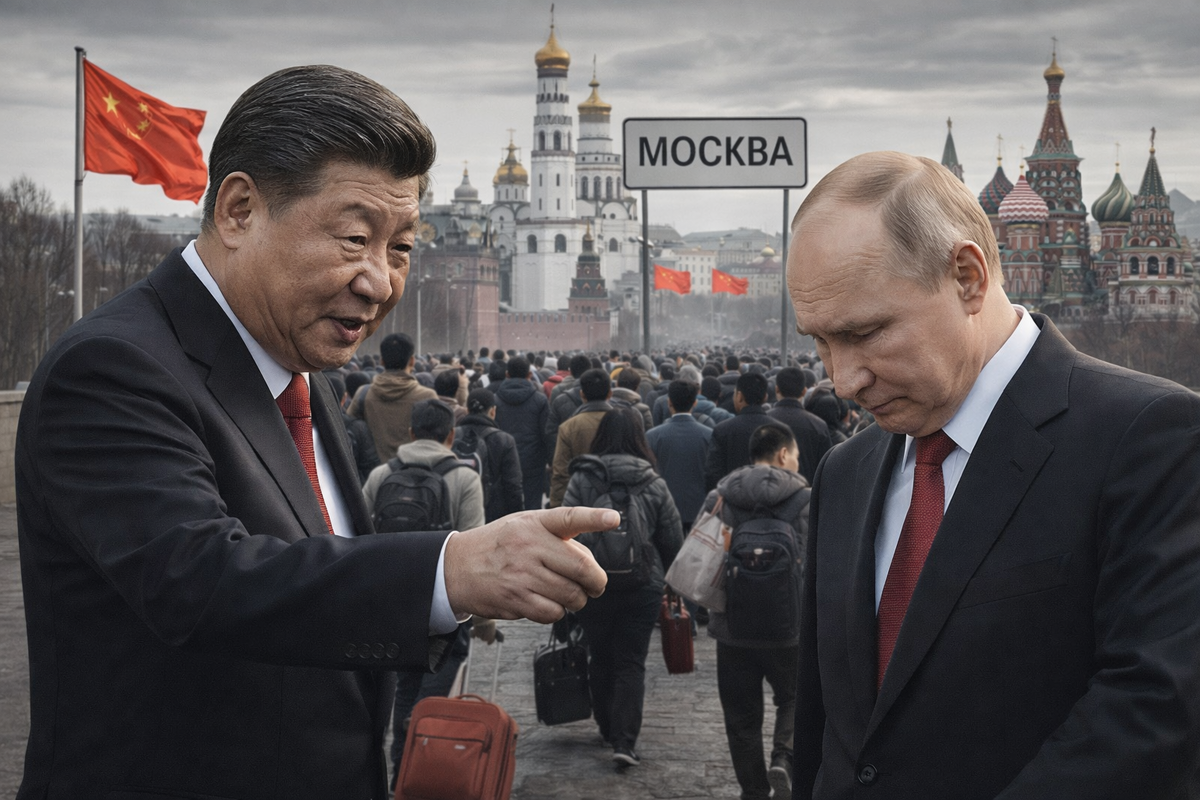
The war in Ukraine exposed a deep strategic problem for Russia that goes far beyond the military front: its growing and dangerous structural dependence on China, which has today become an economic, technological, and logistical support that Moscow can no longer do without without risking its own survival as an autonomous power. Sanctions imposed by the United States, the European Union, and their allies expelled Russia from the Western financial, commercial, and technological system in which it had operated for decades. Demographic, economic, and labor pressure from China on those territories is advancing gradually, without visible military deployments, but with a structural weight that Moscow currently lacks the resources to counteract. For decades, Russia maintained a strong military presence on that border, even after the normalization of relations with Beijing at the end of the Cold War. Vladimir Putin himself has hinted that Russia needs to reinsert itself into alternative financial and commercial markets to avoid falling into a vassal relationship with Xi Jinping. Meanwhile, the reality is that China dominates key sectors of the Russian market. In fact, the Kremlin has lost maneuvering room and autonomy, while China capitalizes on the situation with pragmatism and silence. The paradox is that this subordination clashes with a history marked by distrust, conflicts, and territorial disputes between the two countries, especially in the Russian Far East. The underlying fear in Moscow is that, in the medium term, China may eventually demand historical payment in regions it considers its own, taking advantage of Russia's demographic, economic, and military weakness. However, the war in Ukraine drained resources, personnel, and industrial capacity, weakening its strategic position in Asia. This dependence limits the Kremlin's decision-making capacity and conditions its foreign policy. Analysts agree that, if this trend continues, Russia risks accepting a progressive loss of economic and strategic sovereignty. In this scenario, the war in Ukraine would not be the Kremlin's biggest problem, but merely the trigger for a geopolitical reordering that left Russia more isolated, more dependent, and with fewer options than ever. In Russian circles, there is keen interest in a possible return of Donald Trump to negotiations, seen as an interlocutor willing to negotiate sanctions relief in exchange for economic or strategic concessions. China has come to absorb a decisive part of Russia's energy exports, set prices and purchase conditions, channel transactions through the yuan, and become a key supplier of technology, industrial goods, and dual-use components, both civilian and military. This turn, presented by Moscow as a 'strategic alliance', has resulted in a deeply asymmetric relationship. Russia no longer negotiates on equal terms: it depends on a single partner capable of imposing rules, absorbing surplus at a discount, and conditioning strategic decisions. Chinese brands have replaced Western ones in automobiles, electronics, and consumer goods; the yuan has consolidated as a reference currency in bilateral operations; and Russia's military industry is increasingly dependent on inputs from Chinese factories. The more it depends on China, the less margin it has to protest against this silent expansion. This isolation forced the Kremlin to almost completely reorient its economy towards Beijing. Returning, even partially, to the Western system would allow balancing the scales and reducing the exclusive dependence on Beijing. In this strategy, the US political factor appears. Depopulated regions of Russia's Far East coexist with overpopulated Chinese provinces across the border. Putin's invasion, which was supposed to last three days, is in its third year. In this context, the Kremlin's insistence on seeking a negotiated way out of the sanctions regime and exploring a possible rapprochement with the United States becomes understandable. For Moscow, diversifying partners has ceased to be an ideological option and has become an existential issue.