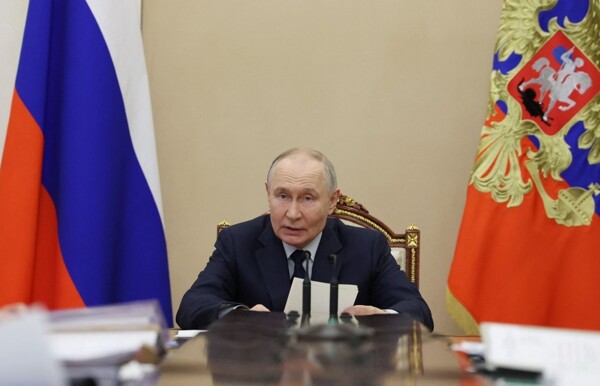
Russian leader Vladimir Putin has finally managed to attract the attention of US President Donald Trump, although he had to resort to the nuclear megaphone, the only ace up the Kremlin's sleeve to still influence the White House. The goal is to make Washington understand that the war in Ukraine is the lesser of its problems and that something much more important is at stake: global strategic stability and nuclear disarmament. The price to pay—the White House chief announced the resumption of tests with nuclear weapons—is minor if we consider that Moscow believes it surpasses its adversary in new-generation arsenal, mainly hypersonic. This is especially true since the Kremlin had to clarify to Trump that it has never conducted a nuclear test, as the last one was carried out by the Soviet Union in 1990. 'We would not like (strategic stability) to continue to degrade more and more,' Russian Security Council Secretary Sergei Shoigu said today, expressing his categorical opposition to future US nuclear tests. Putin's nuclear week Although Trump ultimately rejected the supply of Tomahawk missiles to Kyiv, the Kremlin received the message. To this was added the cancellation of the Budapest summit, a major setback for Russian diplomacy. In response, two years later, Putin personally oversaw the exercises of Russia's land, sea, and air nuclear forces, which included the test launch of a Yars intercontinental ballistic missile (12,000 km range). On Sunday, Putin donned military attire for the third time since the start of the war and met with the Chief of the General Staff to discuss the conflict and the test of the nuclear-powered cruise missile Burevestnik (meaning 'Storm Messenger' in Russian). Curiously, the launch of the Burevestnik—whose range is unlimited as it can operate for days—took place on October 21, the same day it was confirmed that the meeting between Putin and Trump would not happen. And two days later, with a military hospital as the backdrop, the Kremlin leader announced the test of an unmanned Poseidon submarine, a kind of strategic torpedo. 'It is a very powerful weapon that can incapacitate entire states in a war.' To prevent the definitive collapse of the non-proliferation system, Putin proposes to extend the treaty for one year, hoping that by then the war will have ended with Ukraine's capitulation. Hawks are rubbing their hands Russian hawks, who never fully trusted Trump, are applauding Putin, whom they blame for enduring the American leader's outbursts for too long. In his usual style, former Russian President Dmitry Medvedev, who called the sanctions an 'act of war', congratulated 'all of Russia's friends' on the successful test of the Burevestnik on X, a project that had been a headache for the military industry for years due to continuous failures. Days later, he dubbed the Poseidon 'the real weapon of doomsday' and responded to a user's suggestion to use Belgium as a 'testing ground.' 'Then Belgium will disappear,' he said. Meanwhile, Shoigu explained today that Russia will only carry out tests if other major powers do the same, and for this, the Novaya Zemlya test site in the Russian Arctic is ready. However, experts are skeptical about the actual combat value of these newest systems. 'There is the political will, the need for new and powerful armament (…) Neither the Burevestnik nor the rest of the armament fulfill any vital military mission,' commented today Pavel Podvig, director of the Russian Nuclear Weapons project research, to the Meduza portal. The goal is to get the US back to the negotiating table to discuss, among other things, the fate of the last nuclear disarmament treaty between the two powers, New START, which expires in February 2026. Trump wants China to also accept limitations on its offensive arsenal. Ukraine is not the target Both Russian and Western experts, as well as Ukrainian military, understood from the beginning that these nuclear tests were not directed against the Ukrainian army but were a warning to the United States, which approved the first sanctions against Russia since Trump returned to the White House last week. 'You cannot speak with Russia in the language of sanctions,' Russian deputies and senators repeated in unison, referring to the restrictions against the two largest Russian oil companies, Rosneft and Lukoil.