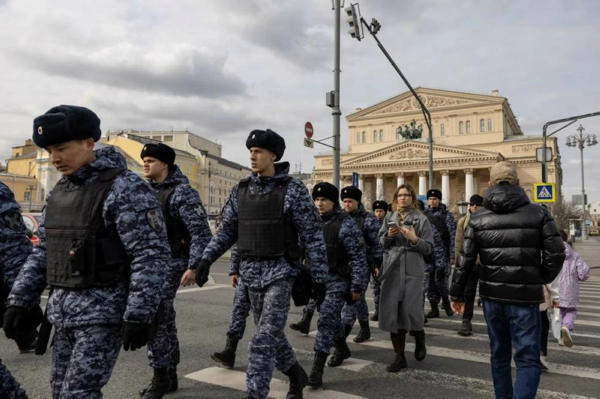
The war not only militarized the border but also accelerated the construction of an inward digital fence. The impact is already being felt in daily life and the economy. This reveals the core of the problem: under the guise of war and defense against drones, the Kremlin is advancing on communications, shrinking privacy, and consolidating a digital control structure increasingly resembling an internal border. Presidential spokesman Dmitry Peskov stated that the disconnections and restrictions are carried out in accordance with current legislation and respond to the need to protect the population from the threat of Ukrainian drones, which can use cellular networks for navigation or coordination. Reuters confirmed that in recent weeks there have been partial or total blackouts of mobile internet in areas of Moscow, St. Petersburg, and other large cities, while the government also moved forward with obstacles to Telegram and the blocking of WhatsApp. But behind the security argument, a deeper dimension emerges. In Moscow, the outages affected electronic payments, transfers, navigation, taxis, and delivery services. In agricultural regions near the border with Ukraine, the situation began to impact even the planting season: a producers' lobby reported that with the mobile internet down, farmers cannot operate mandatory digital systems for declaring seeds, harvests, and sales, exposing them to delays, sanctions, and financial losses in the middle of the season. UK intelligence services have warned that the recent disruptions to Telegram and mobile internet restrictions in Russia reflect the increasingly central role that digital infrastructure has come to occupy within the Kremlin's security policy. The British assessment states that while Moscow presents these measures as a defensive response within the framework of the war it launched against Ukraine, they in fact fit into a broader pattern of controlling the information environment and limiting unofficial channels for the circulation of news, opinions, and criticism. This point is not minor. Telegram has become in recent years one of the most relevant platforms for journalists, bloggers, military analysts, and political commentators within Russia precisely because it allowed for a relatively faster and less domesticated circulation of information than traditional media aligned with power. Analysts, diplomats, and human rights organizations observe that the government of Vladimir Putin has been taking advantage of the war to reinforce its internal disciplinary capacity. Reuters reported that new norms require operators to cut services at the request of the FSB, while experts cited by Chatham House and Human Rights Watch link these blackouts to the deployment of the so-called 'sovereign internet' architecture, which allows the state to intercept, manipulate, or directly disrupt digital traffic on a large scale. This reading coincides with the one maintained by independent observers and with the Russian authorities' own admission, which recognized that the cuts and limitations were deliberate. From the Kremlin, the public explanation revolved around security. The damage, therefore, now falls not only on freedom of information but also on economic activity and the routine of millions of people. In parallel, the siege on applications seems to be pushing the population towards alternatives more controllable by the state itself. Roskomnadzor accused Telegram of violating Russian legislation, while the company denounced that Moscow is trying to force users to migrate to MAX, a state-backed application questioned by critics who consider it a surveillance tool. For British intelligence, this process can no longer be read as a sum of isolated episodes, but as a policy in motion. In that context, slowing down or restricting access to that application not only has a technical effect: it also cools the spread of narratives alternative to the official line. London, March 28, 2026 – Total News Agency-TNA-.

Kremlin's Digital Fence: War as a Cover for Total Control
Under the pretext of war and drone defense, the Kremlin is tightening control over communications and Russia's economy. Analysts see this as an attempt to suppress freedom of speech and strengthen internal control.