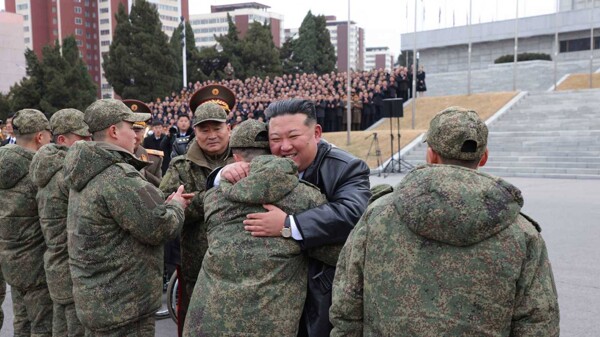
For more than three years since Russia's war against Ukraine, North Korea has emerged as a significant and strong ally to Moscow. By first providing ammunition and weapons, and then sending thousands of its soldiers to fight alongside the Russian army, North Korea has become essential to supporting Russia's war machine. According to reports, North Korea has suffered heavy losses but has also benefited from modernizing its military, solidifying its more stable position in the China- and Russia-led anti-Western alliance. Since the fall of 2024, Pyongyang has sent between 14,000 and 15,000 soldiers to fight alongside Russian forces, according to Western officials. This estimate combines nearly 11 to 12 thousand soldiers, originally deployed in October 2024, with an additional 3,000 reservist troops sent to the frontlines in the following months to compensate for battlefield losses. The vast majority of the soldiers are believed to belong to Pyongyang's elite special forces unit (the Korean People's Army's 11th Corps), or the 'Storm Corps,' which was trained for infiltration, sabotage, and attacking and destroying targets. So far, North Korean forces have only been deployed in the Kursk region in western Russia, where they helped the Russian army regain control of most of the territory that Ukraine had seized during its surprise offensive in August 2024. However, the success of these forces came at a high cost, with more than 6,000 North Korean soldiers killed or wounded, according to the UK Ministry of Defence, despite varying estimates.
Logistical Support In addition to deploying troops, North Korea has sent thousands of workers to support Russia's war efforts. In June 2025, following a meeting between North Korean leader Kim Jong Un and Russian Security Council Secretary Sergei Shoigu in Pyongyang, Kim agreed to send about 5,000 construction workers and 1,000 military engineers to Kursk to help clear mines from the area, among other logistical tasks. North Korea began assisting Russia's war efforts long before its troops were involved in the conflict, first shipping arms in August 2023, when both the Russian and Ukrainian armies were suffering from ammunition shortages as their domestic production could not keep up with the demands of the battlefield. To date, several reports have indicated that North Korea has supplied Russia with ballistic missiles and long-range artillery, multiple rocket launch systems, as well as millions of rounds of ammunition and artillery shells. In July 2025, South Korea's Defence Intelligence Agency estimated that the northern neighbor has sent a total of over 12 million artillery shells, with some Russian units sometimes relying almost exclusively on North Korean-made artillery shells.
Nuclear Warheads Overall, Ukraine's Military Intelligence estimates that North Korea supplies Russia with about half of its artillery shells. North Korea has also supplied Russia with a wide range of weapons. According to the commander of Ukraine's Defence Intelligence, Major General Kyrylo Budanov, Pyongyang has supplied Russia with everything from short-range ballistic missiles 'KN-23' — some of which are capable of carrying nuclear warheads — to D-74 howitzers and self-propelled guns. Budanov stated that Russia and North Korea have finally signed several agreements to begin production in Pyongyang of drones, which Russia has used to target and destroy civilian centers.
A Misconception Despite the difficulty in determining the full extent of the impact of this weaponry on the battlefield, experts from a UN sanctions monitoring group said that North Korean support has significantly contributed to Russia's ability to continue its military advance in Ukraine. It turned out to be a completely wrong assumption that the Russian army would collapse within days, and it soon became clear that Russia lacked the weapons and manpower necessary to continue its offensive. North Korea has proven to be one of the few countries willing and able to provide support to Russia. In July 2023, then-Russian Defence Minister Sergei Shoigu led a delegation to Pyongyang to mark the anniversary of the end of the Korean War, where Kim showcased the country's military capabilities, and the officials discussed military cooperation. Less than a month later, North Korea sent its first shipment of ammunition to Russia, and the two countries strengthened their alliance in June 2024 when Kim and Russian President Vladimir Putin signed a comprehensive strategic partnership treaty that included a mutual defense clause.
Gaining Experience Russia has provided the Korean military with an opportunity to learn and gain experience on the world's most technologically advanced battlefield. Multiple reports from Ukrainian soldiers who fought against North Korean soldiers confirm their ability to adapt to the realities of modern warfare. Indeed, North Korean forces have changed their tactics over time, from launching light infantry attacks on open ground, reminiscent of World War II, to utilizing drone warfare. These tactical developments have pushed the Ukrainian army to make adjustments, seeking to avoid direct engagement with the North Korean soldiers in Kursk due to their skill and speed of advance. Instead, Ukrainian forces have used drones to target the North Korean soldiers and have begun planting increasingly dense fields of anti-personnel mines to slow their progress. Most importantly, Russia has provided North Korea with the knowledge and means to modernize its military capabilities. In exchange for its assistance, Russia has funded numerous North Korean military programs and supplied the country with air defense systems, anti-aircraft missiles, and advanced electronic warfare systems. Russia also continues to share battlefield data from its North Korean ballistic missiles, leading to significant improvements in their accuracy and overall effectiveness. Investigations have revealed that nearly half of the ballistic missiles in North Korea's initial shipment went off course and exploded in mid-air. Since then, their accuracy has improved significantly, according to Budanov, and this comes as Moscow helps North Korea develop its space and nuclear programs.
New Technology Although the extent of Russia's assistance to North Korea is unknown, North Korean leader Kim Jong Un's recent display of new military technology suggests that Russian funding and knowledge transfer are working to improve the country's capabilities. For example, Kim launched the country's largest destroyer in April 2025 and tested various missiles, including a hypersonic cruise missile that experts say resembles a Russian model capable of carrying nuclear warheads. This is a far cry from the military capabilities Pyongyang possessed before Russia's war with Ukraine. Meanwhile, South Korea has warned that deepening cooperation between Moscow and Pyongyang threatens to upset the military balance on the Korean Peninsula.
Despite the heavy losses suffered by North Korea, it has benefited from modernizing its military and solidifying its position in the anti-Western alliance led by China and Russia.